

I was sitting in the garden recently, reading Meditations by Marcus Aurelius — the Roman emperor many people will know as the older emperor at the beginning of Gladiator.
And I came across this passage:
“We should remember that even Nature’s inadvertence has its own charm, its own attractiveness. The way loaves of bread split open on top in the oven; the ridges are just by-products of the baking, and yet pleasing, somehow: they rouse our appetite without our knowing why.”
And I thought:
Wow. Even one of the most powerful men in the world stopped to notice the simple beauty of cracked bread.
Not conquest.
Not status.
Not achievement.
Bread.
A simple, ordinary, everyday thing.
And yet he noticed it.
That, to me, is gratitude.
Not forced positivity.
Not pretending life is easy.
Not ignoring pain, stress, grief, anxiety or responsibility.
But the ability to pause, see clearly, and let something small but real enter the heart.
And as we begin Mental Health Awareness Month, I think gratitude is one of the most powerful places to start.
Mental Health Is No Longer a Side Issue
In the UK, Mental Health Awareness Week runs from 11–17 May 2026, in the US – it’s the whole month of May, with the theme of taking action to support good mental health.
And action is badly needed.
Mind’s Big Mental Health Report 2025 found that 1 in 5 adults in England is living with a common mental health problem, and the estimated cost of mental ill health in England is now around £300 billion per year.
In the United States, the picture is similar. Mental Health America reports that 23.4% of US adults experienced a mental illness in 2024 — more than 60 million people. NAMI gives a similar figure: 61.5 million US adults, or more than 1 in 5.
So this is not a fringe issue.
Mental health affects families, workplaces, relationships, productivity, leadership, physical health and even the stability of our communities.
And while we absolutely need better services, better support and better systems, we also need simple practices people can use today.
Gratitude is one of them.
Gratitude Is Not Weakness — It Is Training
Gratitude Is Not Weakness — It Is Training
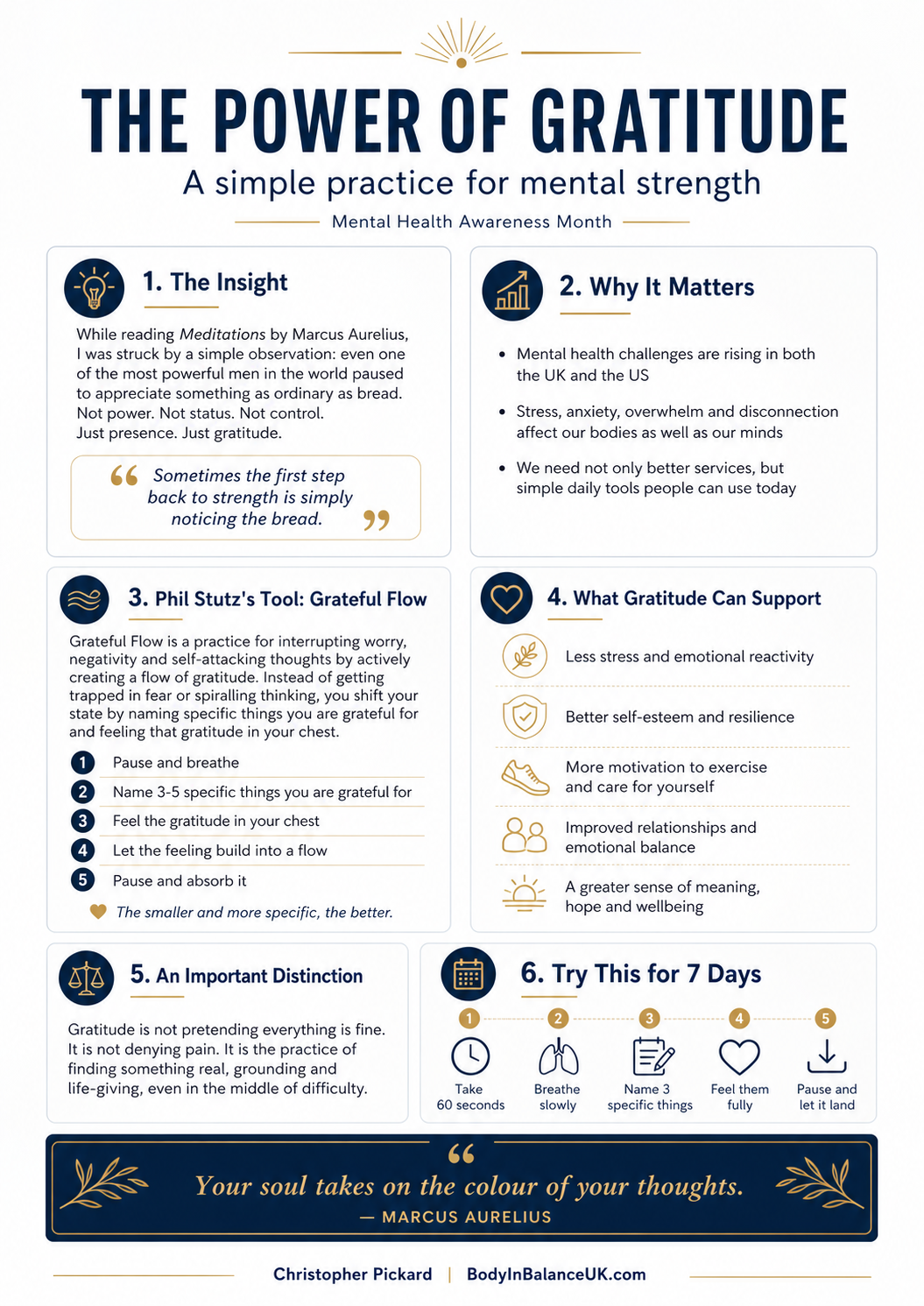
Phil Stutz, the Hollywood psychiatrist known for The Tools, teaches a practice called The Grateful Flow.
The purpose is simple: to interrupt the spiral of worry, fear, self-criticism and negative thinking.
Stutz and Barry Michels describe this negative inner force as “Part X” — the part of the mind that wants to keep us stuck, small, fearful and disconnected from possibility.
The Grateful Flow works by deliberately naming small, specific things you are grateful for.
Not vague things like “my life”.
Specific things.
The warmth of the sun.
A working kettle.
A good conversation.
The smell of coffee.
A dog looking pleased to see you.
The fact your legs carried you downstairs this morning.
You close your eyes, take a breath, and name three or four things. Then you feel the gratitude in your chest. You keep going until it becomes less of a list and more of a flow.
Then you pause.
You let the feeling remain.
And in that moment, you are no longer trapped inside the same old anxious loop.
You have changed state.
That matters.
Because mental health is not only about thoughts. It is about state.
Your nervous system.
Your breathing.
Your chemistry.
Your attention.
Your felt sense of safety, possibility and connection.
What the Research Suggests
Research on gratitude is not saying gratitude fixes everything. It does not replace therapy, medical care, financial support, social connection or proper help when needed.
But it does appear to help.
Harvard Health summarises the research by saying gratitude is strongly and consistently associated with greater happiness, more positive emotion, better relationships, improved ability to deal with adversity, and even better health behaviours.
The classic “counting blessings” study by Robert Emmons and Michael McCullough found that people who regularly focused on gratitude reported better wellbeing than those who focused on hassles or neutral life events.
A 2023 systematic review and meta-analysis also found gratitude interventions were associated with greater gratitude and improved life satisfaction.
Some popular summaries suggest gratitude may be linked with lower stress, better blood pressure, improved self-esteem, greater emotional resilience, more exercise and even longevity. I would treat exact numbers cautiously, but the overall direction is clear: gratitude appears to be one of the simplest low-cost practices for shifting mental and physical state.
But Gratitude Must Be Honest
This is important.
Gratitude should never be used to silence pain.
It should not be used to tell someone in grief, depression, anxiety, trauma or burnout to “just be thankful”.
That is not gratitude. That is spiritual bypassing.
Real gratitude does not deny darkness.
It brings a little light into it.
Marcus Aurelius was not living an easy life. He dealt with war, plague, betrayal, political pressure and immense responsibility.
Yet he still noticed the cracked surface of a loaf of bread.
That is the lesson.
Not that life is always beautiful.
But that even in a difficult life, beauty is still available.
A Simple Practice for This Month
Try this once a day for the next seven days.
Stop for sixty seconds.
Take one slow breath.
Then name three small things you are grateful for.
Make them specific.
Not “my health”.
Try:
“I’m grateful I could walk in the garden today.”
“I’m grateful for that first sip of coffee.”
“I’m grateful someone smiled at me.”
“I’m grateful my body is still trying to heal.”
“I’m grateful I have another chance to begin again.”
Then pause.
Feel it in the chest.
Let the body receive it.
That is the Grateful Flow.
And it might be one of the simplest ways to begin Mental Health Awareness Month.
Not with pressure.
Not with performance.
Not with another thing to perfect.
But with attention.
Because sometimes the first step back to mental strength is not a breakthrough.
Sometimes it is simply noticing the bread.
Which will bring me neatly to my other Mental Health blog – >
